Fabric is the decision that quietly sets everything else about a custom scarf: how a printed design reads, how the finished piece drapes over a shoulder, how warm it is in November, and what a run of a few hundred actually costs. Color and pattern get the attention, but a design that looks crisp on satin can turn muddy on a loose knit, and a weight that feels luxurious as a winter wrap is far too heavy for a summer neck scarf. This guide walks through the fabric families used for custom scarves and how to match them to your print, your climate, and your budget.
Start With the Fiber Family, Not the Swatch
Custom scarves fall into four broad fiber families, and most buying mistakes come from choosing across the wrong one. Silk is the reference point for luxury printed scarves, prized for its sheen, hand, and color depth. Polyester mimics silk at a fraction of the price and is the workhorse for sublimation printing, where full-color artwork is bonded permanently into the fiber. Acrylic and wool occupy the warm, knitted-or-woven end of the market, which is where sports, club, and cold-weather scarves live. And modal, cotton, and their blends sit in the middle as soft, everyday, easy-care options. Deciding the family first narrows every later choice, because print method, weight, drape, and price all follow from the fiber.
Silk and the Momme Question
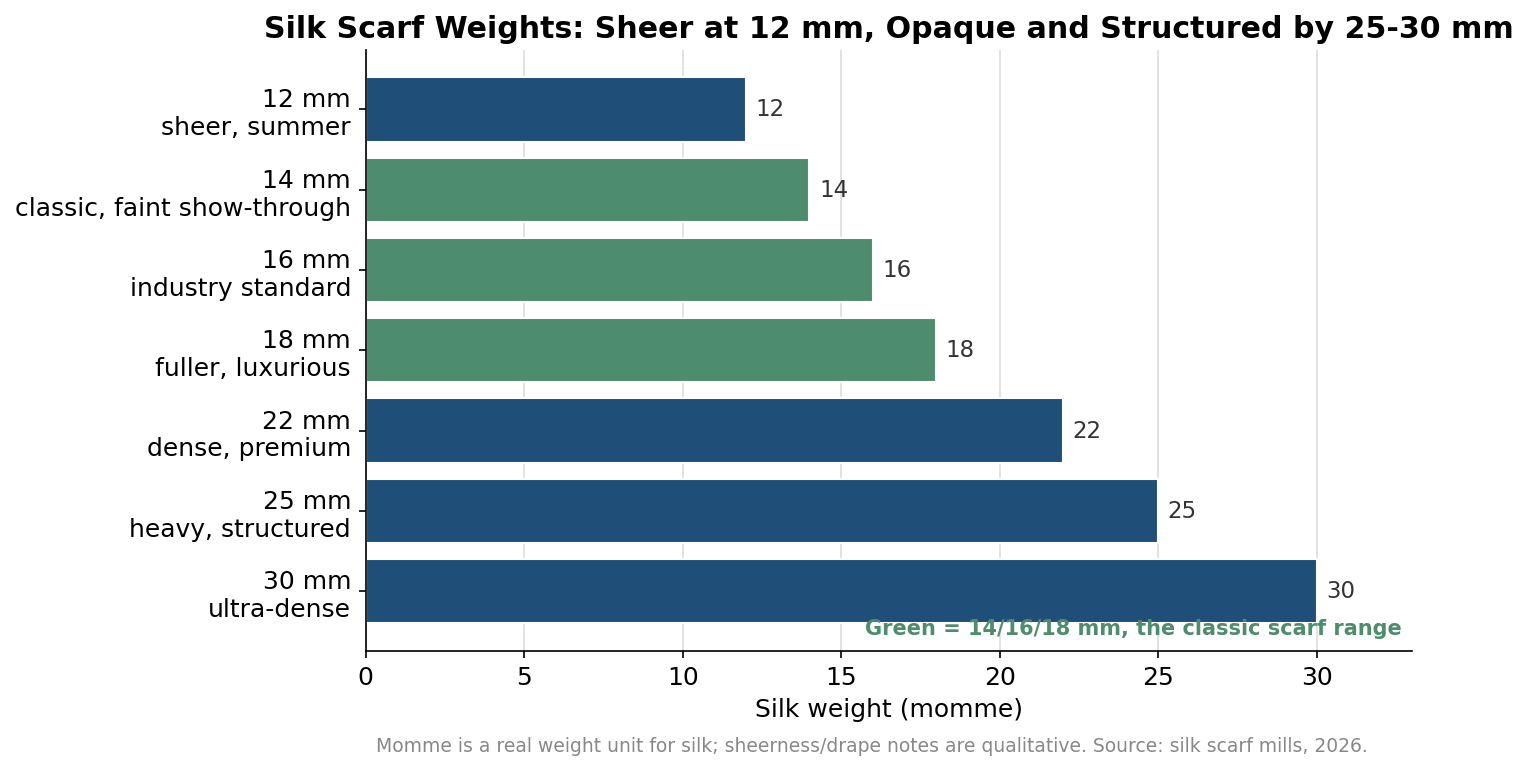
If you go with silk, the single most useful number to learn is momme (abbreviated mm), the traditional unit for silk weight and density. Scarf silk commonly runs from about 12 momme up to 30, and the choice changes the whole character of the piece. At 12 momme the fabric is the lightest and most transparent, lovely for airy summer scarves but visibly sheer. By 14 momme the show-through is only a faint outline; 16 momme is the balanced industry standard; and 18 momme reads as fuller and more obviously luxurious. Push into 22, 25, and 30 momme and the silk becomes dense, opaque, and almost sculptural rather than fluid, which suits structured wraps far more than a scarf meant to knot softly.
For most custom scarf projects, mills recommend the 14-to-18 momme band as the classic, reliable range, and it is a sensible default unless you have a specific reason to go lighter or heavier. Heavier silk always costs more, both because there is more fiber in every square meter and because the premium weights are treated as higher-end goods, so the momme you specify is as much a budget lever as an aesthetic one.
Polyester’s Case: Sublimation and Sharp Graphics
Polyester is where most full-color, logo-heavy, and photographic scarf designs end up, and for good reason. Dye sublimation turns artwork into gas that bonds into the polyester fiber, so the print does not sit on top of the cloth and will not crack, peel, or wash out the way a surface print can. The trade-off is that sublimation only works well on polyester and other synthetics, so if you need edge-to-edge color and fine detail, the fabric choice is largely made for you.
Within polyester there is still range. Polychiffon is the heavier, semi-transparent option that holds clear, crisp prints; satin charmeuse gives a shiny, silk-like face on a budget; and matte crepe is the lightest and drapiest with a low-sheen surface. Woven scarf polyester is commonly quoted anywhere from roughly 200 up to 600 grams per square meter (GSM), with the lighter end feeling silky and fluid and the heavier end feeling substantial and warm. If your priority is a photographic design that survives repeated washing at a controllable cost, polyester with sublimation is usually the answer.
Warmth You Can Wear: Acrylic, Wool, and Fleece
Printed silk and polyester are thin accessory fabrics; when a scarf needs to actually keep someone warm, the conversation moves to knitted and woven constructions. Acrylic is the dominant fiber here because it is soft, genuinely warm, wool-like in feel, and holds its shape and color through heavy repeated wear, which is exactly why stadium, club, and school scarves are overwhelmingly woven or knitted acrylic rather than printed cloth. On those pieces the design is built into the weave as a jacquard or added as embroidery, not printed on the surface, so you specify colors and knit rather than artwork resolution.
Wool and wool blends bring a more luxurious hand and real insulating warmth, with pure wool and cashmere at the premium top of the range; blends cost less and are easier to care for, though wool generally still wants hand washing or dry cleaning. Fleece is a budget-friendly warm option that takes embroidery and appliqué patches nicely. Cotton and modal blends round out the middle, absorbing dye well and wearing comfortably year-round, which makes them a common pick for employee and client gifts that need to feel nice without a luxury price.
Match the Fabric to the Print Method and the Format
The last step is to check that fabric, print method, and finished size all agree. Digital printing suits lightweight silk and polyester and is ideal for samples, small runs and one-off gifts. At Customized Scarves the minimum order is 12 scarves, your free mockup arrives within 24 hours, and standard production ships in about 2 weeks after you approve it, so plan backward from your event date. Sublimation and digital printing favor synthetics and lighter silks; screen printing suits simpler spot-color designs; and woven jacquard or embroidery is the route for warm knitted scarves.
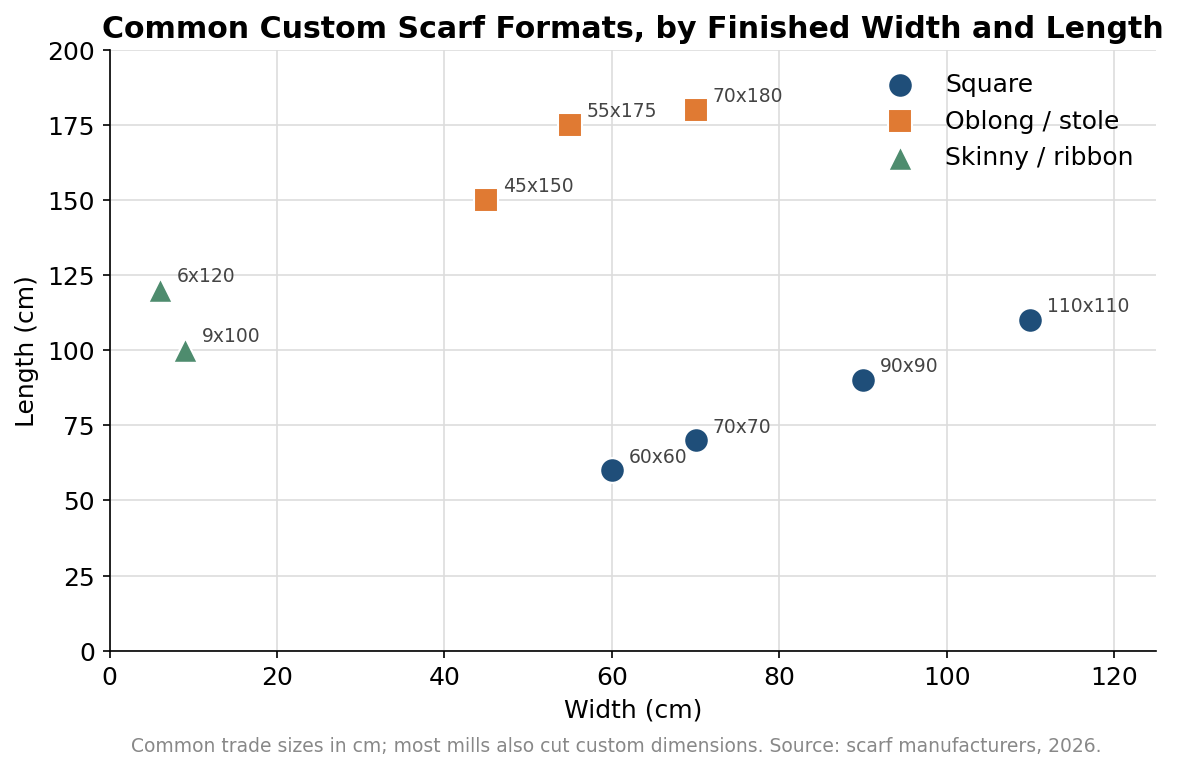
Format matters just as much as fabric. Square scarves cluster around common trade sizes near 60, 70, 90, and 110 cm on a side, while oblong scarves and stoles run long and narrow at sizes like 45 by 150, 55 by 175, and 70 by 180 cm, and skinny or ribbon scarves sit around 6 to 9 cm wide by 100 to 120 cm long. A dense photographic design needs the surface area of a larger square to breathe, while a repeating pattern or a simple logo reads fine on a skinny format. Remember that natural fabrics can shrink a few percent in finishing and that hemming consumes a small margin of cloth, so build a little tolerance into artwork that runs to the edge.
Put together, the fabric decision is really a short sequence: pick the fiber family that fits how the scarf will be used, choose a weight (momme for silk, GSM for polyester, knit for acrylic) that matches the season and the feel you want, and then confirm the print method and size support the design you have in mind. Order a physical sample before committing to a full run, especially when color accuracy or drape is doing the heavy lifting, and the finished scarves will match what you pictured rather than merely approximate it.